How to Scale a Pet Brand With Meta Ads

To scale a pet brand with Meta ads, follow a sequence instead of raising the budget: know your break-even cost per new customer, test creative in batches that protect your winners, keep distinct concepts coming, raise budgets in measured steps, and count new customers in your store data, because pet accounts easily scale on repeat buyers.

Facebook ads for pet brands often look their best at small budgets. Picture a pet brand spending $100 a day at a ROAS of 2 or 3. The budget goes up and the account slides: cost per purchase climbs, returns shrink, and the new spend never holds. Revenue can keep growing while the brand makes less money than before.
That’s the scaling trap, and it’s one of the first things we look for when we work with pet food and supplies brands. It rarely means the brand has run out of customers. It usually means the account was scaled by raising a number instead of following a sequence.
Most pet brand advertising strategies are written for the launch. This guide covers the scaling decisions in Meta ads for pet brands: when to raise the budget and by how much, how to structure for more spend, why creative is the fuel, which number is the guardrail, and how to tell new customers from old ones. If you’re still deciding where Meta fits in your channel mix, start with our guide to pet food marketing strategies.
Why do Facebook ads for pet brands stop working at scale?
Because what made the account work at $100 a day (one winning angle, a simple structure, a small slice of the audience) doesn’t automatically survive a bigger budget. In our experience, five things hold pet brands back on Meta:
- The scaling trap. Results degrade as spend rises, usually for one of three reasons: a structure that can’t absorb more budget, targeting so broad that one creative does all the audience work, or a starting angle (an emotional story, a hard sales push) that only reaches one pocket of buyers.
- Creative fatigue. The ad carrying the account declines: conversion rate drops, CPMs rise, acquisition cost follows. With one or two ads doing all the work, nothing is ready to take over.
- Unit economics. A ROAS of 3, or even 6, doesn’t tell you whether you’re making money until product, shipping, fulfillment, payment processing and discounts come out. It’s the most skipped step and, we’d argue, the most important.
- Repeat purchases. Platforms are good at finding people who already bought, and those reorders get attributed to your ads. The account looks healthy while the customer base stops growing.
- No scaling framework. Budgets go up when someone feels good about last week, instead of following a fixed order of operations.
The fix for the fifth is the framework we use with pet brands: validate your unit economics, establish a creative testing structure, develop distinct creative concepts, increase budgets in measured increments, and track contribution profit and lifetime value.
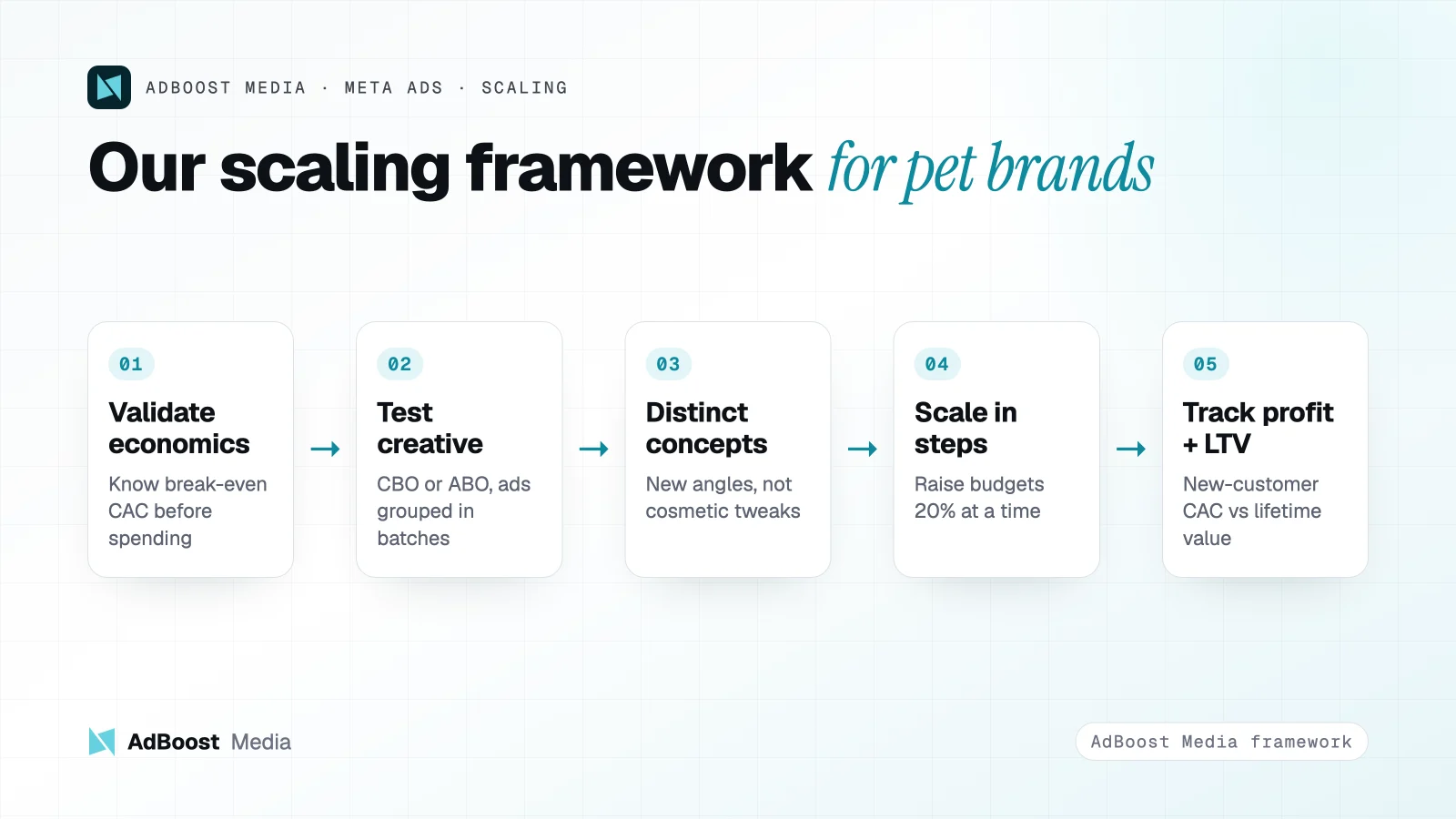
One note on order: tracking, the fifth step, has to be live before the second. You can’t judge a test or a budget increase on numbers you don’t trust, so we set up measurement right after validating the economics.
Prefer to watch? Amir walks through the five scaling mistakes and this framework, step by step, in How to Scale Meta Ads in 2026 (5 Mistakes Pet Brands Make) (9 min, YouTube).
Step 1: What can you afford to pay for a new customer?
You can afford to pay up to your break-even CAC on the first order, plus whatever repeat purchases reliably earn back, and you need that number before scaling Facebook ads for pet brands. It is the one number that matters: your break-even CAC, the most you can pay for a new customer without losing money on the first order. Take the order value and subtract everything it costs to deliver (product, shipping, fulfillment, payment processing, discounts). What’s left is contribution, and on a first order, contribution is your break-even CAC.
Here’s an illustrative example with round numbers. Say your pet food Facebook ads promote a $50 starter bag, and product, shipping, fulfillment and payment processing come to $25. That leaves $25 of contribution, so $25 is your break-even CAC. In platform terms, that’s a break-even ROAS of 2.0, the same formula behind our guide to what counts as a good ROAS for ecommerce.
Discounts move that line fast. Sell the same bag at 30% off and the customer pays $35 while costs stay at about $25. Contribution falls to $10, break-even ROAS jumps to 3.5, and a 3.0 ROAS that looked healthy now loses money on every first order.
Repeat purchases change what you can afford, and in pet they’re the point of the business: if first-time buyers reliably come back for a second bag, you can pay more than first-order break-even. Price that only off repeat behavior you’ve observed in your own cohorts; our guide to setting an ecommerce advertising budget covers allowable CAC and payback windows.
Keep this math in a dashboard that updates with real costs, and ask any agency you evaluate to walk you through it before showing you a ROAS. Leading with “ROAS is 4x” without knowing your margins is reporting, not managing.
If you’re a founder or marketing manager at a pet brand and can’t name your break-even CAC today, work it out before your next budget change. It’s the first thing we do on a call, and you can book time to go through your numbers with us.
Step 2: How should you structure campaigns to carry more spend?
Structure campaigns so new creative is tested in separate small batches and proven winners are consolidated into one campaign that can take a bigger budget. Next comes structure: how many ad sets, how many ads in each, and who decides where the budget goes. One ad set with 50 ads behaves very differently from a set of small batches when the budget rises.
The first choice is CBO or ABO. Campaign budget optimization (CBO, which Meta now calls Advantage+ campaign budget) lets Meta distribute one campaign budget across ad sets in real time; ad set budget optimization (ABO) gives each ad set its own budget.
| CBO (Advantage+ campaign budget) | ABO (ad set budgets) | |
|---|---|---|
| Where the budget lives | One budget for the whole campaign | A budget on each ad set |
| Main strength | Pushes spend toward what’s working | Each batch gets its own budget |
| Main risk | Can spend most of the budget on one ad set | Budget mostly stays where you put it |
| Best fit | Scaling proven creative | Giving new batches a fair test |
Meta notes that a campaign budget might go mostly to one ad set if that gets the best overall results. That’s ideal for scaling a proven winner and poor for testing a new concept, so keep the two jobs separate.
We group new creative into batches: small ad sets of a few ads each, launched together. For Facebook ads for pet brands starting at around $100 a day, our default is one campaign with two batches of three creatives. With more budget we prefer to test five batches at a time, backed by a real concept strategy.
Batches also protect what’s working. Meta treats adding a new ad to an ad set as a significant edit that restarts that ad set’s learning, while adding a new ad set to a campaign on Advantage+ campaign budget doesn’t reset the others. So new creative goes in as a new batch, never into the winning ad set. Meta’s campaign budget best practices also recommend adding ad sets in bulk, and note that the more ad sets and ads a campaign holds, the longer it may spend in learning.
The goal: as many winning creatives as possible, consolidated into one campaign at a higher budget.
Step 3: Why does scaling need distinct creative concepts?
Scaling needs distinct creative concepts because, with broad targeting, each concept reaches a different pocket of pet parents, and one angle runs out of buyers long before the budget does. Budget is what you scale; creative is what lets it scale. With broad targeting and Advantage+ audience doing more of the audience work, the creative effectively decides who sees your ads: a picky-eater hook finds a different pet parent than a convenience or price-per-meal hook. An account built on one angle runs out of buyers for that angle.
Distinct means different, not tweaked. A new background or a swapped headline on the same video is the same ad to people already tired of it. Meta’s engineers point the same way when describing its ad delivery system, writing that “Increased ad diversity can improve people’s experience with ads and drive better advertiser outcomes” (Meta Engineering, Andromeda). So each new batch should test a different problem, promise or reason to buy now. Formats are a separate decision; for scaling, the point is volume and distinctness. For the signs an ad is wearing out, see our guide to spotting when your ads need a creative refresh.
A budget increase with no new creative behind it mostly buys more frequency on the same ads, and that holds across pet product Facebook advertising, from food and treats to toys and grooming supplies. Have the next batch tested and waiting before you scale.
Step 4: How much should you raise the budget at a time?
Raise it in measured steps: our rule of thumb, which we treat as close to law on every ad platform, is never more than 20% at a time.
Meta doesn’t publish a percentage. Its significant-edits documentation says a budget change may or may not restart learning depending on its size: $100 to $101 isn’t likely to, $100 to $1,000 may, and on Advantage+ campaign budget one change can send several ad sets back at once. During the learning phase, Meta says ad sets are less stable and usually have a higher CPA, typically exiting after about 50 results in the week after their last significant edit. In our accounts, a big change costs three to five days of unstable delivery. The 20% step adds spend without paying that cost every time.
Take the next step only when:
- New-customer CAC is holding under break-even after the last increase, in your store data as well as Ads Manager.
- A tested batch is in reserve to absorb the extra spend.
- Delivery has settled, with nothing still in learning from the last change.
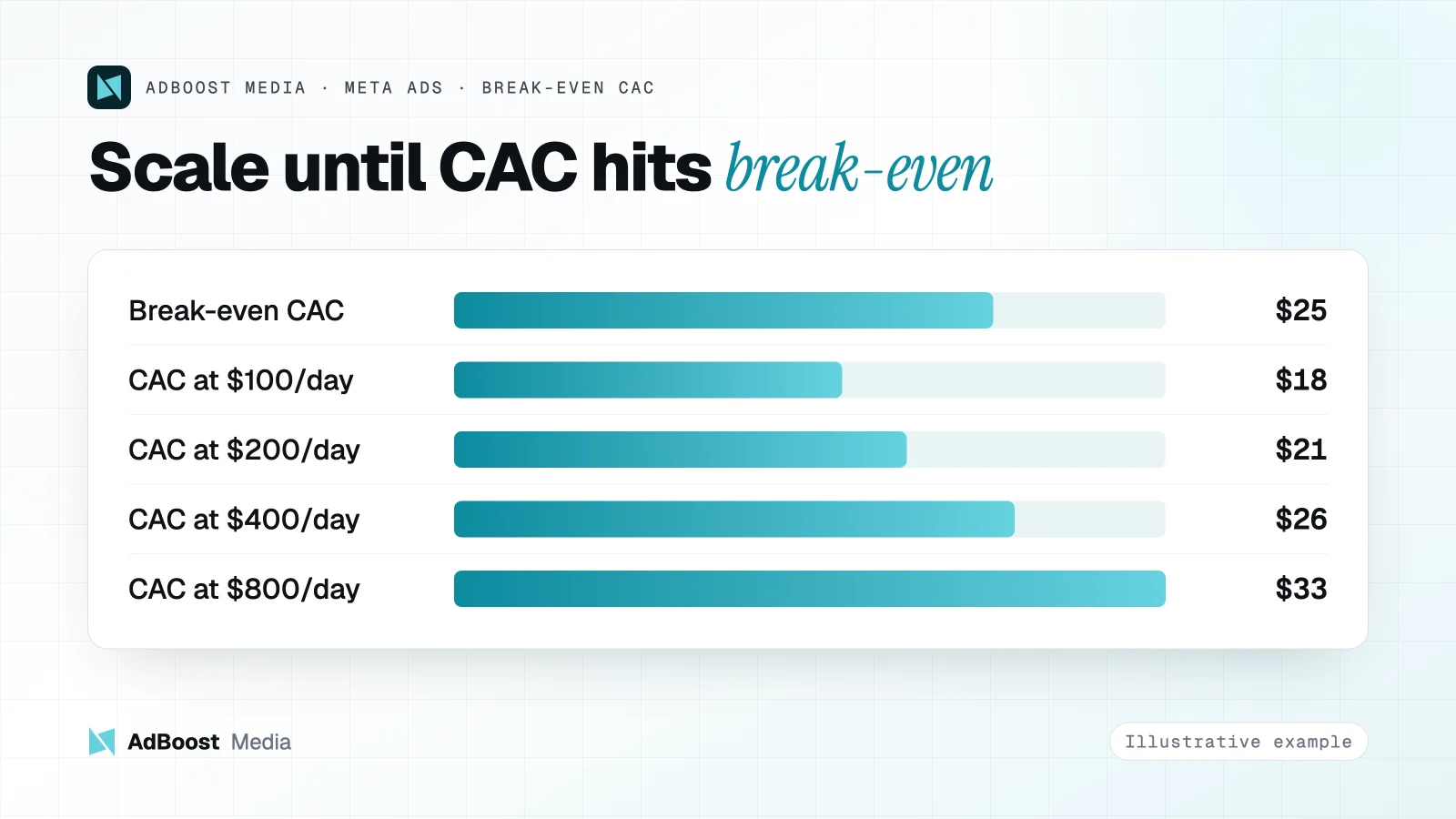
Keep stepping while cost per new customer stays under break-even. In the illustrative account below, the pet food brand from step 1 pays $18 per new customer at $100 a day and $21 at $200, then crosses its $25 break-even before $400. Past that point, more budget buys revenue at a loss; the answer is new creative or a better offer, not a bigger number.
To scale faster, make one deliberate jump instead of several panicked ones: raise the budget to the new level, launch it with a larger set of creatives, and let it learn without touching it. Meta gives similar advice for campaign edits: make changes in bulk, not one at a time. For the full method beyond pet, including the learning phase and Learning Limited, see our guide on how to scale Meta ads. Scaling into Black Friday? Our holiday paid media guide covers what to change this late.
Step 5: How do you tell new customers from repeat buyers?
You tell them apart by giving Meta your customer list for reporting, splitting existing customers out with structure, and counting first-time customers in your store data rather than in Ads Manager. Scaling only pays if it grows the customer base, and pet runs on reorders. Chewy, for example, reported that sales to its Autoship customers made up 84.6% of net sales in the quarter ended August 2, 2026. Your brand isn’t Chewy, but if you sell anything that runs out, many of this month’s buyers may have bought before.
In our experience, Meta will readily serve ads to past purchasers and take credit for orders they would have placed anyway, and the same pattern shows up across pet brand paid social advertising on TikTok and Snapchat. Platform ROAS rises while new customers stay flat, and larger brands feel it most. Separate the two groups:
- Tell Meta who your customers are. Audience segments, built from custom audiences such as your customer list, unlock reporting breakdowns across new, engaged and existing customers in Advantage+ sales campaigns.
- Split existing customers out with structure. Meta’s developer documentation says the old existing-customer budget cap isn’t available for new Advantage+ campaigns, and replicates it with two ad sets: one targeting your existing-customer audience under a spending limit, one excluding it. Advantage+ audience supports custom audience exclusions as a hard limit.
- Count new customers outside the platform. Store data, such as Shopify’s New vs returning customers report, or a third-party analytics tool shows how many first-time customers you gained. Ad spend divided by that number is a cost per new customer no dashboard can inflate.
Then put it in one dashboard: contribution profit after ad spend, what a new customer costs, and what that customer is worth over time, from real cohorts. That tells you whether a CAC above first-order break-even is an investment or a leak. Make scaling calls on blended numbers, not platform ones; our guide to blended ROAS vs platform ROAS explains why.
How do you diagnose why scaling broke?
When Facebook ads for pet brands break at scale, find the cause before changing anything else; another edit often makes it worse. If every campaign moved on the same day, check the pixel and your store’s orders first. Then match the symptom:
| What you see after scaling | Likely cause | What to do |
|---|---|---|
| Higher CPA, ad sets showing “Learning” | The budget jump reset learning | Hold for three to five days; step by 20% next time |
| Ad sets stuck on “Learning limited” | Budget spread across too many batches | Run fewer batches, or more budget per batch |
| Frequency and CPMs up, CTR down on the same ads | Creative fatigue | Launch a new batch of distinct concepts |
| CAC climbs with every increase, no single ad fading | Your angles have hit their ceiling | New concepts for new buyers, or hold at the last profitable level |
| Strong CTR, high CAC | The click isn’t converting | Check the offer, landing page, checkout and GA4 |
| Platform ROAS up, new customers flat | Spend drifting to existing customers | Segment reporting, then split or exclude customers |
The website row is the one most teams skip. Strong click-through with a high CAC means the ads work and the visit doesn’t. Check what visitors do in GA4 or your session data, and fix the offer or page from there. No budget increase fixes a page that doesn’t convert.
What is the right order for scaling a pet brand on Meta?
Scaling pet brands with Meta ads comes down to order: know your break-even CAC, measure new customers separately, test creative in batches that protect your winners, keep distinct concepts coming, and raise budgets in steps small enough that the account never starts over. Get the order right and Facebook ads for pet brands can keep paying as the budget grows.
We run Meta ads management and creative for ecommerce brands across pet, CPG, apps, fashion, wearables and consumer tech, and pet brings its own version of the scaling problem: small first orders, and a business built on the second one. Our pet marketing work for pet food and supplies brands covers the rest of the funnel, and if you are comparing partners, start with how to choose a pet marketing agency.
If you’re a founder or marketing manager at a pet brand weighing your next budget increase, talk it through with us first. We’ll look at your break-even CAC, your new-versus-returning split and your creative pipeline, and tell you whether the account is ready to scale.
Frequently asked questions
How much should you increase a Facebook ad budget at once?
Our rule of thumb for Facebook ads for pet brands is to raise a budget by no more than 20% at a time. Larger jumps tend to send ad sets back into Meta's learning phase, which in our experience costs three to five days of unstable delivery. Take the next step only once new-customer CAC has held under break-even after the last increase.
Should pet brands use CBO or ABO on Meta?
Pet brands can use both, because CBO and ABO do different jobs. ABO puts a budget on each ad set, so every new creative batch gets a fair test. CBO, which Meta now calls Advantage+ campaign budget, moves spend toward the strongest ad sets, which suits scaling proven winners. CBO can spend most of its budget on a single ad set.
What is break-even CAC for a pet brand?
Break-even CAC is the most a pet brand can pay to acquire a new customer without losing money on the first order. Take the order value and subtract product cost, shipping, fulfillment, payment processing and discounts; what remains is the break-even CAC. A $50 order with $25 of costs has a break-even CAC of $25, or a break-even ROAS of 2.0.
Why does ROAS drop when you scale Meta ads?
ROAS usually drops at scale because the setup that worked on a small budget can't absorb more spend. The campaign structure may not suit scale, broad targeting may be leaning on one creative angle that only reaches one pocket of buyers, or the winning ads may be fatiguing. Higher spend then buys more expensive customers and diminishing returns.
How many creatives does a pet brand need to scale on Meta?
A pet brand starting at around $100 a day can test properly with six creatives: our default is one campaign with two batches of three ads. Larger budgets can test five batches at a time. More important than the count is that each batch tests a genuinely distinct concept rather than small edits of last month's winning ad.
How do you know if Facebook ads are bringing in new customers?
To know whether Facebook ads bring in new customers, separate new buyers from existing ones. Build audience segments in Meta for new, engaged and existing customer reporting, split or exclude existing customers when acquisition is the goal, and count first-time customers in your store data. Ad spend divided by first-time customers gives a cost per new customer.
Is your pet brand ready to scale on Meta?
Book a short strategy call. We'll check your break-even CAC, how much of your Meta spend reaches new customers, and whether your creative pipeline can carry a bigger budget, then tell you honestly whether to scale, hold, or fix something first.
Apply to partner